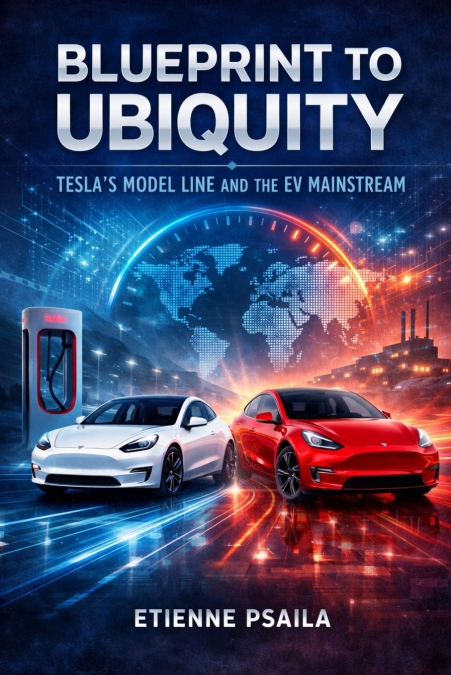
Etienne Psaila
Tesla did not simply sell electric cars-it sold a new definition of what an electric car was supposed to feel like. From the first high-performance halo products to the mass-market scale of Model 3 and the everyday practicality of Model Y, Tesla fused range, speed, software, and charging access into a single ownership experience. The result was not only a lineup, but an ecosystem that trained consumers to expect continuous improvement, seamless routing to fast charging, and a vehicle that behaved more like a connected platform than a fixed machine.Blueprint to Ubiquity follows the decisions-technical, operational, and commercial-that turned EVs from a niche alternative into a default consideration for mainstream buyers. It tracks how Tesla’s charging strategy evolved into a market-wide convergence moment, how over-the-air updates rewrote the meaning of 'model year,' and how Autopilot and Full Self-Driving ambitions collided with regulation, scrutiny, and real-world edge cases. Along the way, it treats factories, supply chains, and pricing as the real levers of scale, showing how manufacturing footprint and battery economics shaped what Tesla could build, where it could deliver, and at what speed.The book closes by examining the consequences of success. Once EVs become normal, novelty stops carrying the category, competition compresses margins, and the hard work shifts to reliability, service capacity, infrastructure uptime, and policy stability. Using Tesla’s trajectory as the thread, Blueprint to Ubiquity explains how the EV mainstream was engineered-and what it takes to sustain it in a regulated, fiercely contested global market.